
How to Search Criminal Dockets
A Guadalupe County criminal docket search starts with jurisdiction. Felonies go to the District Clerk because the district courts hear felony causes. County-level misdemeanors generally route through County Court at Law 2 and the County Clerk. Fine-only Class C cases may sit with one of four Justice Courts or with the municipal court named on a city citation. The District Clerk docket page is an official starting point, but it required authentication during the county research session. The local Tyler help lists civil, family, probate, and calendar categories rather than a general criminal category.
Gather the court name, full party name, cause number if known, and a filing or setting date range. Those details help the clerk separate similar names and direct the request. Do not send a Social Security number or full driver-license number in ordinary email. When the online docket is blocked or incomplete, use the criminal department phone, email, mail, or clerk counter. A statewide re:SearchTX search is another lead, but its coverage does not prove that every Guadalupe County criminal case is online.
- Read the citation, notice, or cause number to identify the court level.
- Check the official docket route for that court and note the date searched.
- Contact the District Clerk criminal department or County Clerk when no public result appears.
- Match the court, cause number, filing date, and setting before relying on an entry.
- Ask the custodian for a plain or certified copy if the docket alone is not enough.
Guadalupe Criminal Portal Limits
Guadalupe County does not present one complete public form for every criminal docket. The county Tyler/Odyssey PublicAccess portal is linked for local case access, yet its help identifies civil, family, probate, guardianship, and court-calendar searches. The official District Clerk docket page displayed login fields during research. Neither fact means a record is sealed. It means the public route may depend on a clerk or coordinator.
The re:SearchTX portal offers Cases, Filings, Text in Documents, and Hearings tools after sign-in. State reports describe broad integration work, but public access and court coverage vary. Treat a zero-result search as a lead, not a certified no-record statement. Save the query terms and search date, then ask the court custodian to confirm the case.
The official Guadalupe County docket entry page shows why a clerk fallback matters.
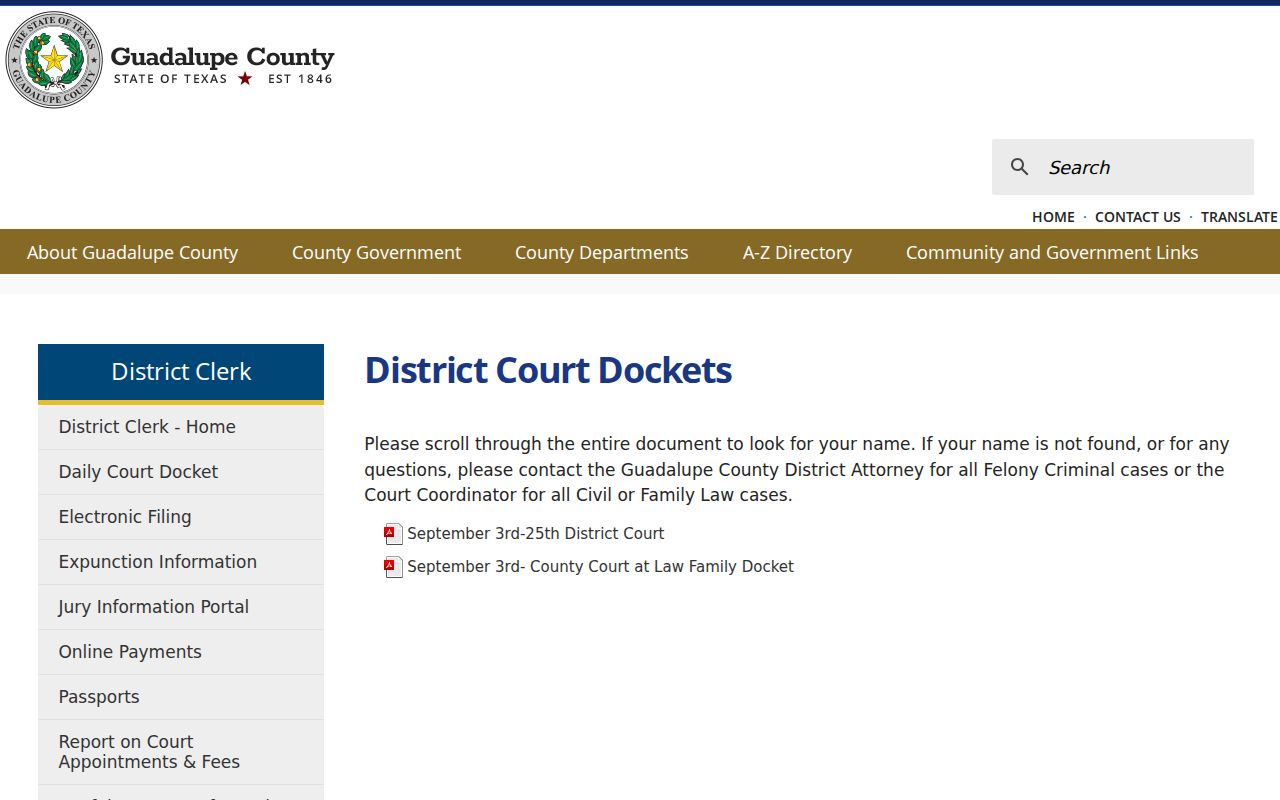
The captured page connects users with district docket documents while also showing that access can require authentication.
What a Criminal Docket Shows
A Guadalupe County criminal docket is a chronological index. It may identify the charge, filing or indictment, scheduled proceedings, motions, orders, plea, disposition, judgment, sentence, or appeal notice when those items are public. The local research did not expose a safe case-level sample behind the authenticated docket, so no fixed county column set should be assumed. Read the underlying order when a brief entry is unclear.
| Cause number | The court-assigned key. District assignment letters can include A, B, C, or E. |
|---|---|
| Charge | The alleged offense or charging instrument, not a finding of guilt. |
| Setting | An arraignment, pretrial, announcement, motion, plea, or trial date. |
| Plea | Guilty, not guilty, or nolo contendere when entered and recorded. |
| Disposition | The recorded result, which should be checked against the signed judgment or order. |
A case style or party name alone is not enough to establish identity. Confirm the cause number and court. Bond, custody, warrant, and probation lines may change, and their current status belongs with the issuing court or clerk.
Guadalupe Criminal Court Routes
The court level controls both the docket and its custodian. Guadalupe County has four district courts for felony matters: the 25th, 2nd 25th, 274th, and 456th Judicial District Courts. County Court at Law 2 handles misdemeanor criminal matters along with juvenile, mental-health, occupational-license, and related work. The four Justice Courts hear Class C cases and perform magistrate, bail, warrant, and arraignment functions. Municipal clerks keep city Class C and ordinance dockets.
| Matter | Likely court | Record route |
|---|---|---|
| Felony | District Court | District Clerk criminal department |
| County misdemeanor | County Court at Law 2 | County Clerk court records |
| County Class C | Justice Court | Specific precinct clerk |
| City Class C | Municipal Court | City court named on citation |
The County Court at Law 2 page identifies its criminal and specialty jurisdiction.
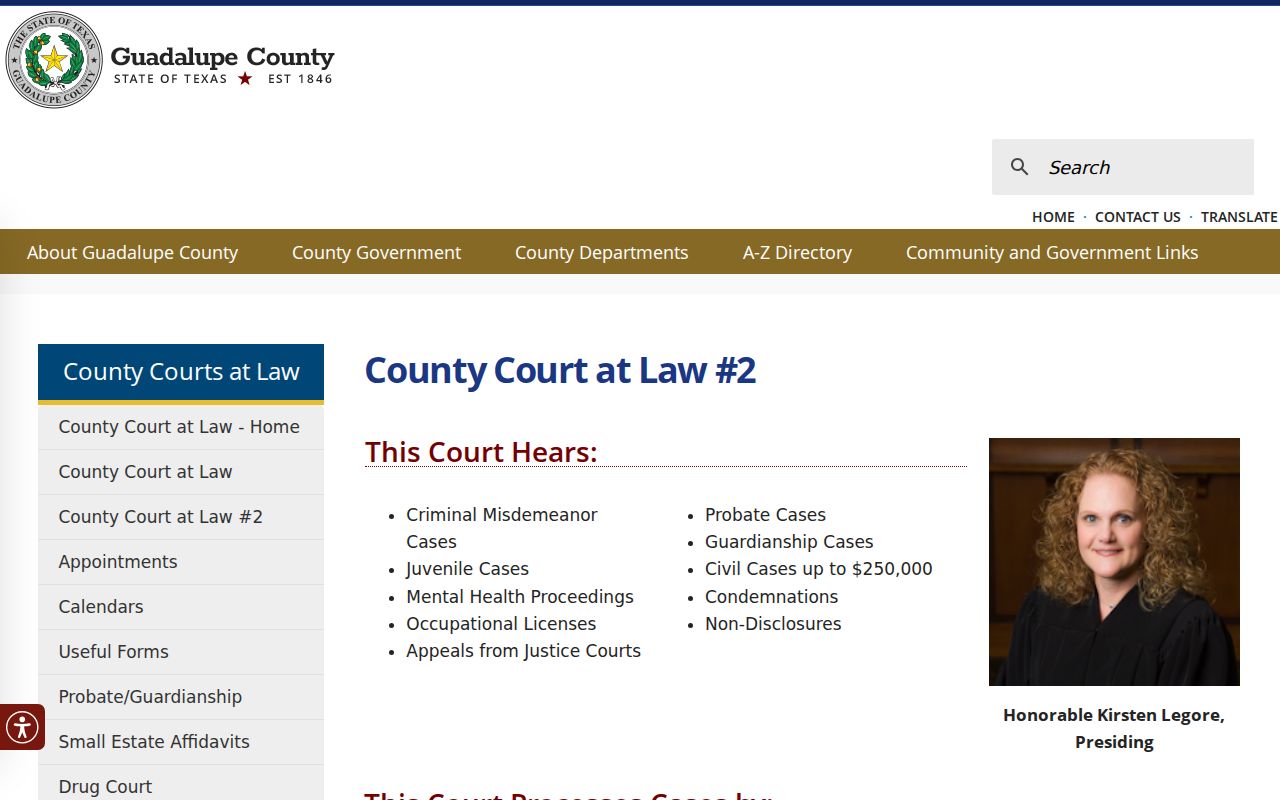
This court-specific route helps keep a county misdemeanor search distinct from a district felony or city citation search.
Stages on a Criminal Docket
A criminal docket may begin with a complaint, information, or indictment, depending on the court and offense. An indictment is a grand-jury charging instrument. It is not a conviction. Arraignment addresses the charge, identity, rights, and plea under the court's process. Later entries can include bond events, discovery matters, motions, pretrial settings, an announcement, a plea hearing, trial, judgment, sentence, and appeal notice.
Guadalupe local rules describe a criminal pretrial nonjury docket generally called at 9:00 a.m. They also discuss limited pretrial settings and movement to contested motions or announcement after three unresolved settings unless the court approves otherwise. That framework does not set the course of every case. The signed order, current notice, and clerk's docket control.
Docket flow: Charge Filed › Arraignment › Pretrial › Plea or Trial › Disposition › Sentencing
Request a Guadalupe Criminal Docket
When a portal fails, contact the custodian directly. The Guadalupe County District Clerk lists 830-303-8875 for criminal and collections questions and uses dccourts@guadalupetx.gov. The main office is at 211 W Court Street, Seguin, Texas 78155. A Schertz satellite is at 1101 Elbel Road. The County Clerk court-record line, 830-303-8861, serves county-level civil, probate, and misdemeanor records through cccourts@guadalupetx.gov.
State the court, record type, cause number if known, party name, and date range. Say whether a docket sheet, a named order, or a certified copy is needed. Ask about the fee and delivery path before paying because the District Clerk copy fee was not located in the official sources. Mail and in-person counter service remain alternatives to phone and email. No official source confirmed a public terminal, so call before traveling for terminal access.
District Clerk Criminal Department
211 W Court Street, Seguin, TX 78155
830-303-8875
dccourts@guadalupetx.gov
Which Court Holds Criminal Dockets
The district court cause letter can help route a Guadalupe County criminal docket. Local rules map A to the 2nd 25th, B to the 274th, C to the 25th, and E to the 456th District Court. These are court assignments, not offense codes. The 25th and 2nd 25th also serve Guadalupe, Gonzales, Colorado, and Lavaca counties, while the 274th includes Guadalupe, Hays, and Comal. Confirm both county and court before reading a regional calendar.
A County Court at Law 2 record does not belong to the District Clerk merely because it is criminal. Likewise, a Justice Court or city docket stays with its own clerk. The court named on the citation, notice, or order is the best first clue. The broader Guadalupe County case search methods can help locate a cause number, but the right custodian supplies an authoritative copy.
Guadalupe Expunction Docket Boundaries
Expunction is a statutory process under Texas Code of Criminal Procedure Chapter 55. It is not a general request to erase an unfavorable entry. If a court grants relief, the order directs listed agencies to remove or destroy eligible arrest and court records as the statute provides. The county's routing information names the District Clerk, County Clerk, County Attorney, Sheriff, magistrate, probation agencies, state courts office, corrections department, and public safety department among potential recipients.
The District Clerk expunction page provides the local agency-routing context.
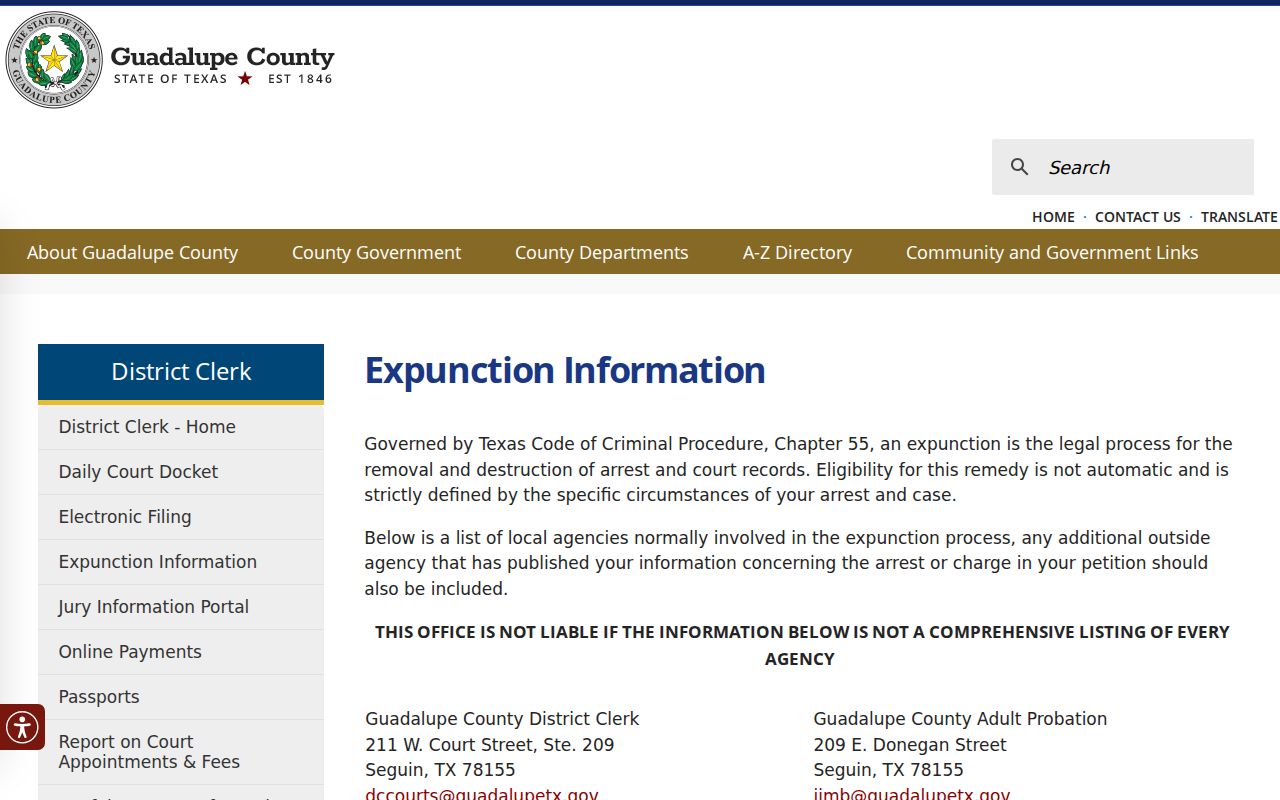
The routing list shows why an expunction is a court remedy involving specific custodians, not a simple portal edit.
Juvenile and child-protection records follow separate confidentiality rules. A public calendar date does not open the underlying file. Specialty programs such as Veterans Treatment Court, Drug Court, and High Risk Probation Court are program routes, not broad public criminal indexes. Ask the program or court about access rather than assuming ordinary docket visibility.
Public Access and Sealed Criminal Dockets
Texas court access depends on the kind of record. Judicial records are generally open under Rule of Judicial Administration 12, subject to stated exceptions. Court case records are governed by common law, statutes, court rules, and the clerk's custody rather than a simple Texas Public Information Act request. Sensitive identifiers, sealed files, expunged material, and juvenile records may be withheld or redacted.
Key Rules:
Texas Rule of Judicial Administration 12 sets access and exception rules for judicial records.
Texas Family Code Chapter 58 restricts juvenile records and identifying information.
Texas Code of Criminal Procedure Chapter 55 governs eligible expunctions.
Absence from a public search may reflect restricted access, a portal gap, spelling, date range, or the wrong court. It does not by itself show that no case exists. Verify a disposition with the signed order or judgment and the clerk that holds it.
Guadalupe Criminal Docket Dispositions
A disposition line records a procedural or final result, but a short label cannot answer every question. A dismissal may have terms or later action. Deferred adjudication or disposition has conditions that depend on the court and statute. A conviction entry should be checked against the signed judgment and sentence. An appeal notice can mean review is pending.
Match the cause number, court, date, and underlying order. Never use a name alone to connect a docket to a person, and never treat a charge or indictment as a finding of guilt.